
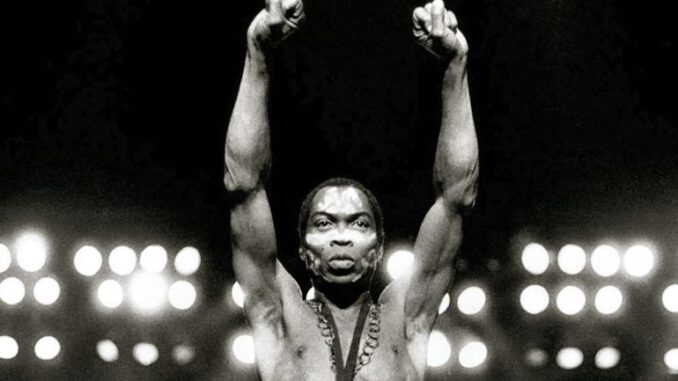
Fela Kuti remains one of the most influential musicians in African history. Known for creating the revolutionary genre Afrobeat, Fela Kuti combined music, politics, and activism in a way that permanently changed African cultural expression.
Throughout his career, Fela used music as a weapon against corruption, colonial influence, and military dictatorship in Nigeria. His fearless political activism, unique musical style, and rebellious lifestyle turned him into a global cultural icon.
This detailed biography explores Fela Kuti’s early life, education, music career, political activism, achievements, legacy, and net worth.
Early Life and Family Background
Fela Kuti was born Olufela Olusegun Oludotun Ransome-Kuti on October 15, 1938, in .
He was born into a highly educated and politically active family that played a major role in Nigeria’s early nationalist movement.
His father, , was a respected Anglican minister, school principal, and educationist.
His mother, , was a renowned women’s rights activist and one of the most prominent anti-colonial figures in Nigerian history.
Funmilayo Ransome-Kuti was a fearless political organizer who led protests against colonial taxation policies imposed on Nigerian women.
Growing up in such a politically conscious household profoundly influenced Fela’s worldview and later shaped his role as a musical activist.
His brothers also achieved great success in their respective fields. One of them, , later became a well-known human rights activist and medical doctor.
Education in Nigeria and the United Kingdom
Fela Kuti attended during his early education.
In 1958, he was sent to the United Kingdom to study medicine. However, Fela had little interest in becoming a doctor.
Instead, he enrolled at the , where he studied music composition and trumpet performance.
During his time in London, Fela developed a passion for jazz and highlife music.
He formed a band called Koola Lobitos, which performed a blend of jazz and West African highlife music.
This experience helped him develop the musical foundation that would later evolve into Afrobeat.
Musical Awakening in the United States
A major turning point in Fela’s life occurred when he traveled to the United States in 1969.
During this visit, he encountered the Black Power movement, which deeply influenced his political ideology.
He was introduced to African-American activist , who exposed him to revolutionary literature about African identity, colonial oppression, and black liberation.
Inspired by these ideas, Fela transformed both his music and his message.
He abandoned the Westernized name “Ransome” and embraced his African identity more strongly.
This period marked the birth of Afrobeat, a new genre combining:
- Traditional Yoruba rhythms
- Jazz instrumentation
- Funk grooves
- Political lyrics
Creation of Afrobeat
Fela Kuti officially developed Afrobeat in the early 1970s.
Afrobeat was unlike any music that had existed before.
The genre featured:
- Long instrumental compositions
- Heavy percussion
- Powerful horn sections
- Socially conscious lyrics
Fela’s band, , became one of the most powerful musical ensembles in Africa.
The band often consisted of dozens of musicians performing energetic live shows that could last for several hours.
Afrobeat quickly became a cultural movement rather than just a musical style.
The Kalakuta Republic
In 1970, Fela established a communal compound in Lagos called the .
Kalakuta functioned as a self-declared independent state where Fela, his band members, and followers lived together.
The compound also served as:
- A recording studio
- A rehearsal space
- A political headquarters
From Kalakuta, Fela openly criticized Nigeria’s military government through his music and public speeches.
Confrontation with the Nigerian Government
Fela Kuti became one of the most outspoken critics of corruption and dictatorship in Nigeria.
His songs frequently attacked government officials, military rulers, and foreign exploitation.
Some of his most famous protest songs include:
- Zombie
- Water no get enemy
- Sorrow Tears and Blood
“Zombie” mocked Nigerian soldiers by comparing them to mindless robots who blindly followed orders.
The song angered the military government and led to one of the most violent attacks in Nigerian cultural history.
In 1977, Nigerian soldiers raided the Kalakuta Republic.
During the attack:
- Fela was severely beaten
- His studio was destroyed
- His mother was thrown from a window
She later died from injuries sustained during the attack.
This tragic event further radicalized Fela’s political activism.
The Afrika Shrine
Fela’s primary performance venue was the legendary .
The Afrika Shrine became a cultural hub where thousands of fans gathered to watch Fela perform live.
His concerts combined music, political speeches, and social commentary.
These performances often lasted all night and became legendary in African music history.
Today, a modern version known as the New Afrika Shrine continues to host music events in Lagos.
Musical Achievements
Fela Kuti recorded an extraordinary catalog of music during his lifetime.
He released more than 50 albums, many of which are considered masterpieces of African music.
Some of his most influential albums include:
- Zombie
- Expensive shit
- Gentleman
These recordings continue to influence musicians across the world.
Artists from various genres — including jazz, hip-hop, and electronic music — cite Fela as a major inspiration.
Political Activism
Fela did not limit his activism to music.
In 1979, he founded a political party called the .
He attempted to run for the presidency of Nigeria but was prevented from participating in the election.
Throughout his life, Fela was arrested and jailed multiple times by Nigerian authorities due to his outspoken criticism of the government.
Despite these challenges, he refused to stop speaking out against injustice.
Personal Life
Fela Kuti’s personal life was as unconventional as his music.
In 1978, he famously married 27 women in a single ceremony, many of whom were dancers and singers in his band.
His lifestyle attracted significant controversy but also reflected his rejection of traditional societal norms.
Fela fathered several children, including internationally recognized musician and Grammy-nominated artist , both of whom continue to perform Afrobeat music today.
Death
Fela Kuti passed away on August 2, 1997, in at the age of 58.
His death was caused by complications related to , according to medical reports.
More than one million people reportedly attended his funeral procession in Lagos.
His death marked the end of an era, but his influence remains alive.
Fela Kuti Net Worth
During his lifetime, Fela Kuti was not primarily motivated by financial success.
His focus was activism and artistic expression rather than commercial wealth.
At the time of his death, his estimated net worth was believed to be between $1 million and $5 million.
However, the value of his music catalog and cultural legacy has grown enormously since then.
Legacy and Global Influence
Fela Kuti’s influence extends far beyond Nigeria.
His music laid the foundation for modern Afrobeats and inspired generations of African artists including:
- Burna Boy
- WizKid
- Davido
International artists have also acknowledged his influence, including:
- Erykah Badu
- Questlove
His life story even inspired the Broadway musical , which introduced his story to global audiences.
Today, Fela Kuti is remembered not only as a musical genius but also as a fearless activist who used art to challenge power.
His legacy continues to inspire artists, activists, and cultural thinkers around the world.
Be the first to comment